
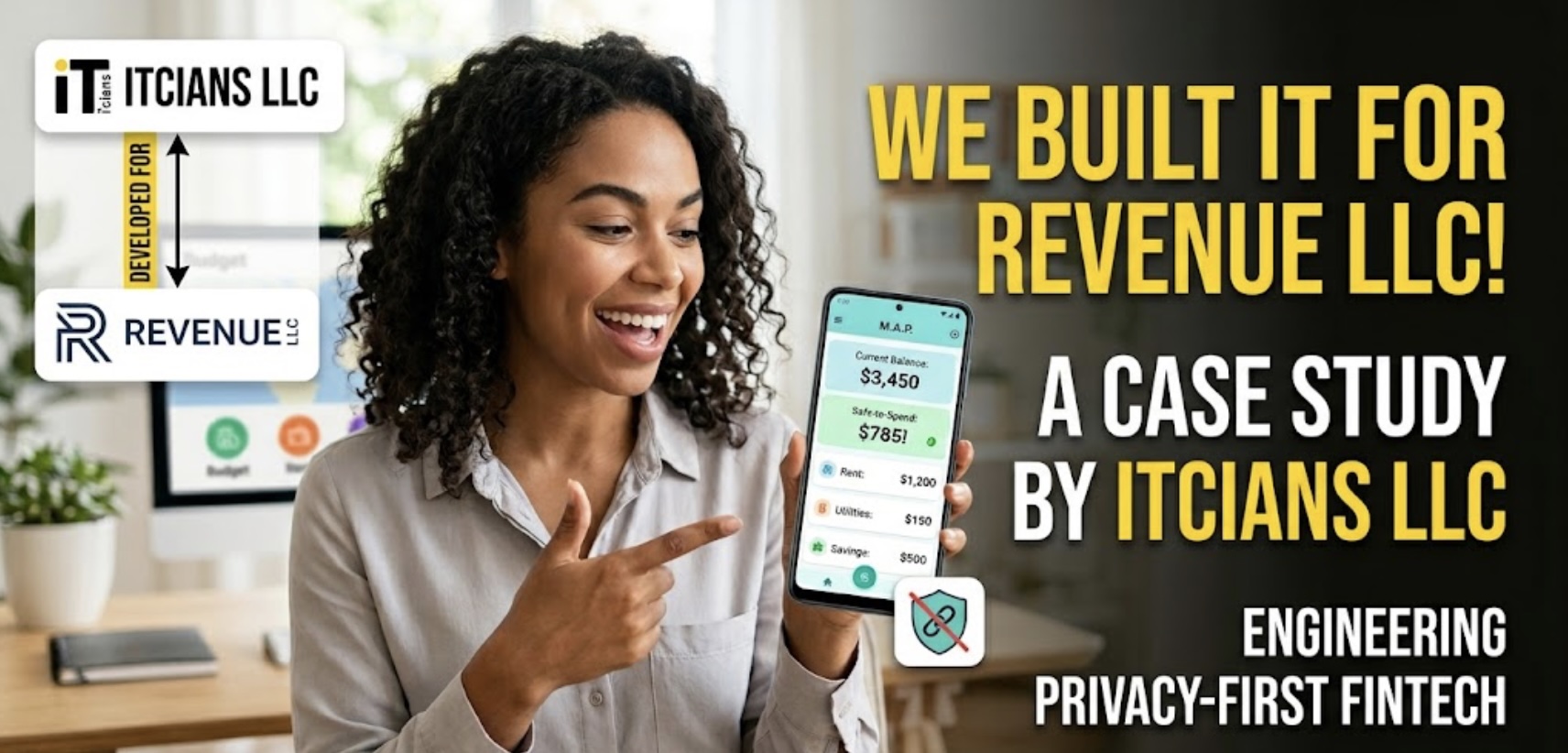
As software engineers, we are frequently tasked with balancing robust feature sets against strict security constraints. When Revenue LLC approached my team at ITcians LLC, they presented us with a fascinating architectural challenge: build a personal finance and budgeting mobile app that explicitly rejects cloud-side data syncing, data collection, and third-party financial APIs.
The product concept was M.A.P. (Money Allocation Planner). The objective was clear: create an intuitive, zero-trust financial sanctuary where users have absolute clarity over their day-to-day spending without sacrificing their personal data footprints.
Here is a technical breakdown of how we architected, engineered, and shipped this local-first mobile application to the Google Play Store.
The Challenge: Eliminating the Vulnerabilities of Automated Chaos
Most mainstream personal finance applications rely heavily on automated backend syncs (e.g., Plaid API integrations). While convenient, this architecture presents two glaring problems for privacy-conscious users:
- Attack Surface Expansion: Forcing users to link sensitive banking credentials to third-party databases exposes them to catastrophic cloud-side data leaks.
- The “Available Funds” Illusion: Raw checking account balances are inherently misleading. If an app simply pulls a static balance without accounting for impending fixed bills, the user operates on a false sense of financial security until a transaction bounces.
Revenue LLC wanted a proactive alternative. They needed an app that computed a real-time “Safe-to-Spend” limit using data stored exclusively on the user’s physical device hardware.
The Engineering Strategy: Designing a Zero-Trust Mobile Core
To deliver on the client’s strict data safety requirements, we engineered the application around a local-first architecture.
[User Capital Input] ➔ [State Engine Isolates Allocated Bills] ➔ [Instant Safe-to-Spend Output]
1. Zero-Data Offline Storage
Because our data safety mandate was absolute, we designed M.A.P. to collect and share zero third-party data. The application uses highly optimized, encrypted local database storage. Financial metrics, custom allocations, and salary inputs never traverse a network interface; they reside strictly within the application’s secure sandboxed storage on the host device.
2. Proactive Allocation Engine
Instead of building a reactive ledger system that looks backward at past transactions, we engineered a forward-looking calculation matrix. The core engine instantly processes user inputs across custom digital envelopes (e.g., Rent, Utilities, Savings) and offsets them against upcoming due dates. It dynamically generates the precise, guilt-free amount a user can burn right now.
3. Granular State Safeguards & UX Stability
When a mobile application runs entirely on manual user inputs, data entry friction and human error are your biggest hurdles. A stray swipe should never compromise data integrity.
To safeguard the user’s local financial vault, we implemented strict state validation routines alongside intentional Archive and Delete confirmation prompts within the UI layer. This minimized accidental state destruction while keeping the application lightweight, responsive, and deterministic.
Development Lifecycle & QA Benchmarks
High-performance utility software requires precise execution. Before deploying the application to production, our team at ITcians executed a rigorous 14-day closed testing phase on the Google Play Console.
Our QA process focused heavily on:
- Asynchronous Notification Reliability: Ensuring Smart Bill Reminders triggered accurately via local device scheduling without relying on external push servers (APNs/FCM) that could leak metadata.
- State Persistence Testing: Validating that local DB writes safely committed during low-battery or sudden app lifecycle termination events.
Architectural Comparison Matrix
| Technical Metric | Traditional Financial Apps | M.A.P. Architecture (ITcians LLC) |
|---|---|---|
| Data Sync Layer | Remote Cloud Databases / Third-Party Banking APIs | Local-First Vault. 100% on-device data containment. |
| Network Dependency | Constant connection required for API syncing | Fully Functional Offline. Zero network requests executed. |
| Security Surface | High (Vulnerable to server-side breaches) | Minimal. Data security relies on native OS-level encryption. |
| UI Responsiveness | Subject to API latency, token expiration, and lag | Sub-millisecond State Updates. Instant computational rendering. |
Key Takeaways: Shipping Reliable Client Products
Collaborating with Revenue LLC to develop M.A.P. perfectly illustrates our core philosophy at ITcians LLC: We build software driven by intent, security, and exceptional performance. We took an ambitious, privacy-centric design constraint and transformed it into a lightning-fast, production-ready tool that is live on the market today.
As a Technical Lead, there is nothing more rewarding than delivering clean, highly structured codebases that match a client’s business model while rigorously respecting the end-user’s right to digital privacy.
🛠️ Need a Robust Mobile or Web Solution Engineered?
Whether you are looking to architect a secure local-first application, integrate highly customized state engines, or scale a technical platform, my team and I have the infrastructure to build it.
- Explore our development agency: Visit ITcians LLC
- See our engineering in action: Download M.A.P. on the Google Play Store