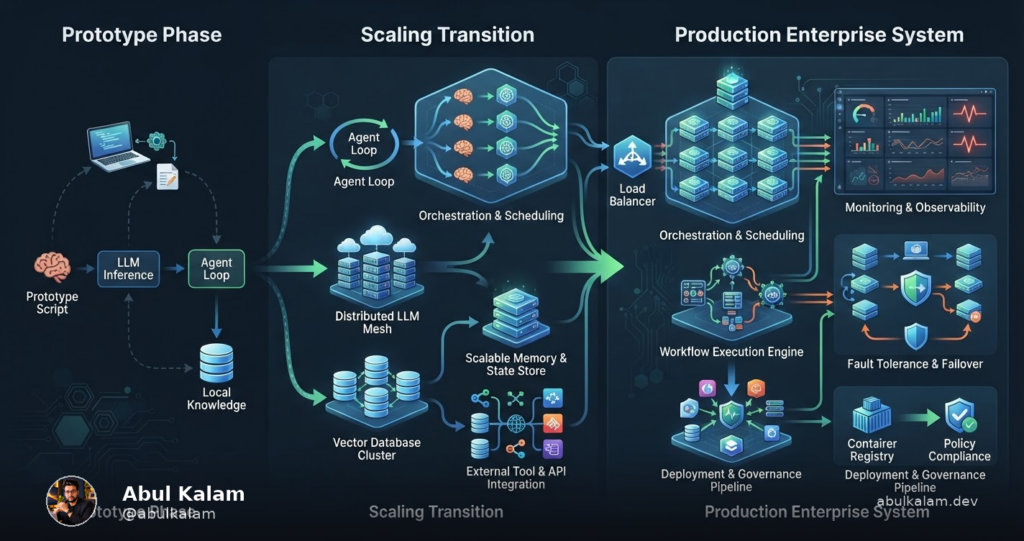

Standardized agent skills are rapidly reshaping how engineering teams design, deploy, and scale autonomous workflows in production environments. As foundation models proliferate, relying on monolithic prompt templates and proprietary plugin wrappers creates fragile systems that break under real-world usage. By transitioning to modular, vendor-agnostic agent skills, software architects can decouple reasoning engines from underlying runtime execution.
The Architectural Bottleneck in Early AI Integrations
During the initial wave of generative AI adoption, most developer implementations relied on ad-hoc tool calling. An engineer would expose an internal REST endpoint, manually write a verbose JSON schema into a system prompt, and pray that the model consistently parsed the parameters. When requirements evolved or a project migrated from one frontier model to another, the entire integration had to be re-engineered from scratch.
This tightly coupled approach created significant engineering friction across several key areas:
- Zero Portability: Tool declarations tailored for one provider frequently degraded when invoked by an alternative LLM.
- Security and Sandboxing Gaps: Running execution environments without isolated runtime layers exposed production infrastructure to unverified function calls.
- Maintenance Overhead: Updating a single parameter required synchronizing schema definitions across prompts, orchestrators, and backend handlers.
As highlighted by recent open-source innovations tracked across the GitHub trending repositories, the software engineering community is decisively moving away from custom glue code in favor of reusable runtime protocols and contract-based interfaces.
Why Agent Skills Are Replacing Brittle Custom Integrations
An agent skill is more than a simple function definition; it is a self-contained, typed capability boundary that encapsulates authentication, schema validation, input sanitation, and execution logic. Much like microservices brought sanity to monolithic web architectures, standardized agent skills bring deterministic reliability to probabilistic AI workflows.
When you encapsulate capabilities into discrete agent skills, you introduce several distinct architectural advantages:
1. Model-Agnostic Interoperability
By defining capabilities through open specifications—such as the Model Context Protocol (MCP) or standardized OpenAPI skill manifests—your execution layer remains agnostic to the underlying LLM. Whether your orchestrator runs Claude 3.5 Sonnet, GPT-4o, or a locally fine-tuned open-weights model, the skill harness translates structured model outputs into verifiable system actions without rewriting backend adapters.
2. Type Safety and Runtime Guardrails
Production systems cannot tolerate hallucinations in database operations or payments. Modern developer tooling allows engineers to enforce rigorous schema validation using tools like Pydantic, Zod, and JSON Schema before an external call is ever dispatched. If the model generates malformed inputs, the skill runtime intercepts the payload locally, generates a deterministic error prompt, and asks the agent to self-correct without executing broken side effects.
3. Modular Testing and Observability
Isolating skills into modular packages makes automated evaluation and unit testing feasible. Software engineers can mock external APIs, evaluate skill selection accuracy across test datasets, and trace latency or token costs per tool execution. This level of granular telemetry is essential for debugging multi-agent swarms operating in enterprise settings.
Implementing a Modular Agent Runtime in Production
Transitioning to an agent-skill-driven architecture requires treating tool development as an independent tier of your system design. A resilient production deployment typically consists of three coordinated layers:
- The Skill Registry: A centralized repository that catalogs available functions, semantic descriptions, parameter requirements, and permission policies.
- The Execution Harness: An isolated runtime environment that handles rate limiting, credentials management, error handling, and sandbox isolation.
- The Orchestrator: The high-level agent loop that handles context management, state persistence, planning, and dynamic skill selection.
By enforcing clear contracts between these layers, organizations build software that survives rapid model turnover while continuously expanding the autonomous capabilities of their applications.
Building Future-Ready Autonomous Systems
The transition toward standardized developer tooling and reusable agent skills marks a critical maturation phase in AI engineering. Autonomous applications are no longer proof-of-concept experiments stitched together with prompt hacks; they are distributed software systems that demand disciplined architecture, type safety, and modularity.
As a senior software engineer and product builder, Abul Kalam helps forward-thinking companies design resilient web, mobile, and AI-integrated products. If you are preparing to scale intelligent agents across your business operations or need help architecting robust AI infrastructure, connect with Abul Kalam to build your next production-grade solution.