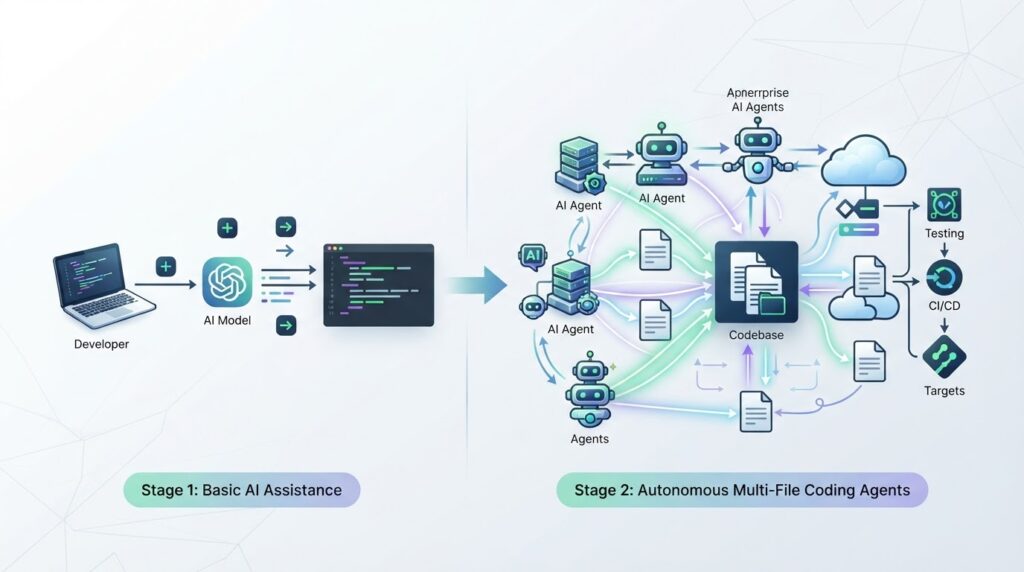

Scaling SaaS architecture requires balancing rapid feature release cycles with high availability, clean domain boundaries, and bulletproof database design. As modern software systems expand, engineering bottlenecks rarely stem from pure algorithmic complexity; they stem from context fragmentation, sprawling integration layers, and repetitive orchestration overhead. By adopting modern AI developer tooling and terminal-first agent harnesses, engineering teams can dramatically accelerate development cycles while strengthening underlying system resilience.
As a senior engineer and product builder at Abul Kalam, I have evaluated dozens of AI integrations across full-stack applications. The shift we are witnessing today is unmistakable: developer tooling is moving from simple syntax prediction to agentic harness execution capable of understanding deep codebase topologies.
The Evolution of Modern Developer Tooling in Systems Engineering
Traditional software development lifecycle (SDLC) models treat IDEs as passive text editors. Even initial implementations of AI code generation were limited to local autocompletions that frequently hallucinated interfaces or missed global state patterns. That era is definitively over.
Modern developers now build within specialized environments like Cursor or operate with terminal-first agent CLI harnesses. Instead of guessing parameters, these agent systems construct internal knowledge graphs across database schemas, API specs, environment configurations, and dependency trees. A glance at trending open-source repositories on GitHub reveals a massive surge in developer-focused agent frameworks, automated codebase auditing skills, and contextual indexers designed specifically to inspect and safeguard enterprise repositories.
1. Automating Multi-Tenant Database Schemas and Migrations
Multi-tenancy sits at the core of scalable SaaS systems. Whether you opt for row-level security (RLS) within a shared PostgreSQL database or separate schema-per-tenant isolation, drafting schema migrations is often error-prone. AI agent harnesses change this equation completely.
By feeding your data models and domain isolation rules into an agent workflow, you can automate critical schema evolution tasks:
- Predictive Indexing: Identifying missing composite indexes and query bottlenecks before code reaches staging environments.
- Zero-Downtime Migration Generation: Structuring backward-compatible column expansions, dual-write migrations, and contract updates.
- Strict Isolation Checks: Enforcing multi-tenant tenant ID constraints across all join queries and views automatically.
2. Maintaining Architecture Boundaries with Knowledge Graphs
As microservices and modular monoliths scale, architectural drift becomes an existential threat. New endpoints accidentally bypass middleware, domain models leak into transport layers, and circular dependencies emerge quietly. Modern AI harnesses prevent this by querying codebases as semantic knowledge graphs.
When an engineer initiates a refactor or introduces a new third-party integration, the agent analyzes the full call graph. It verifies that authentication handlers, rate limiters, and logging wrappers remain strictly decoupled from business logic. This provides instant architectural feedback directly in the developer’s local development environment, eliminating days of manual pull request review churn.
3. Automated End-to-End Integration and Regression Test Suites
Test coverage is frequently the first victim of aggressive roadmap milestones. Yet in distributed SaaS architectures, lack of deterministic integration tests is the primary cause of catastrophic production regressions. Modern AI agent tools solve this by treating test generation as an orchestration workflow:
- The agent parses API route handlers, request validation schemas, and expected failure modes.
- It synthesizes mocked payloads covering boundary conditions, malformed tokens, and edge-case concurrency scenarios.
- It executes test runs in isolated test containers, captures assertion failures, and automatically refactors integration tests to match revised API contracts.
This closed-loop testing drastically lowers regression rates while maintaining comprehensive coverage across backend APIs, background queues, and webhook dispatchers.
4. Terminal-First Agent Harnesses and CI/CD Security Audits
Deploying AI agents directly into the command-line interface and deployment pipeline allows teams to run continuous audits before code ever merges into main branches. With dedicated security audit skills, agent harnesses inspect inbound pull requests for credential leaks, deserialization vulnerabilities, and missing authorization guards.
Rather than relying solely on static AST linters that produce high rates of false positives, contextual agents evaluate security within the exact operational context of your infrastructure. They trace user inputs from HTTP entry points down to database drivers, flagging unauthenticated pathways and data leakage risks in real time.
Best Practices for Scaling SaaS Architecture Safely
While AI agent tools deliver exponential productivity boosts, senior engineering leaders must institute clear guardrails to preserve architectural integrity:
- Deterministic Code Review: Treat every line of agent-generated code with the same scrutiny as junior developer output. Human oversight on systems architecture remains non-negotiable.
- Modular Service Boundaries: Keep service interfaces lean and explicitly typed so AI agents can parse context without exceeding token windows.
- Local Sandboxing: Run autonomous terminal agents inside isolated devcontainers to prevent unintended system side effects during exploratory refactoring.
Conclusion: Future-Proof Your SaaS Engineering Stack
Successfully scaling SaaS architecture is no longer just about choosing the right cloud provider or database engine; it is about building high-velocity developer infrastructure powered by intelligent tooling. When engineers leverage AI agent harnesses for schema design, integration testing, and architectural auditing, they spend less time battling technical debt and more time delivering tangible product value.
If you are looking to modernize your engineering workflows, scale your full-stack applications, or implement enterprise-grade AI integrations, explore how we build scalable digital solutions at abulkalam.dev.