

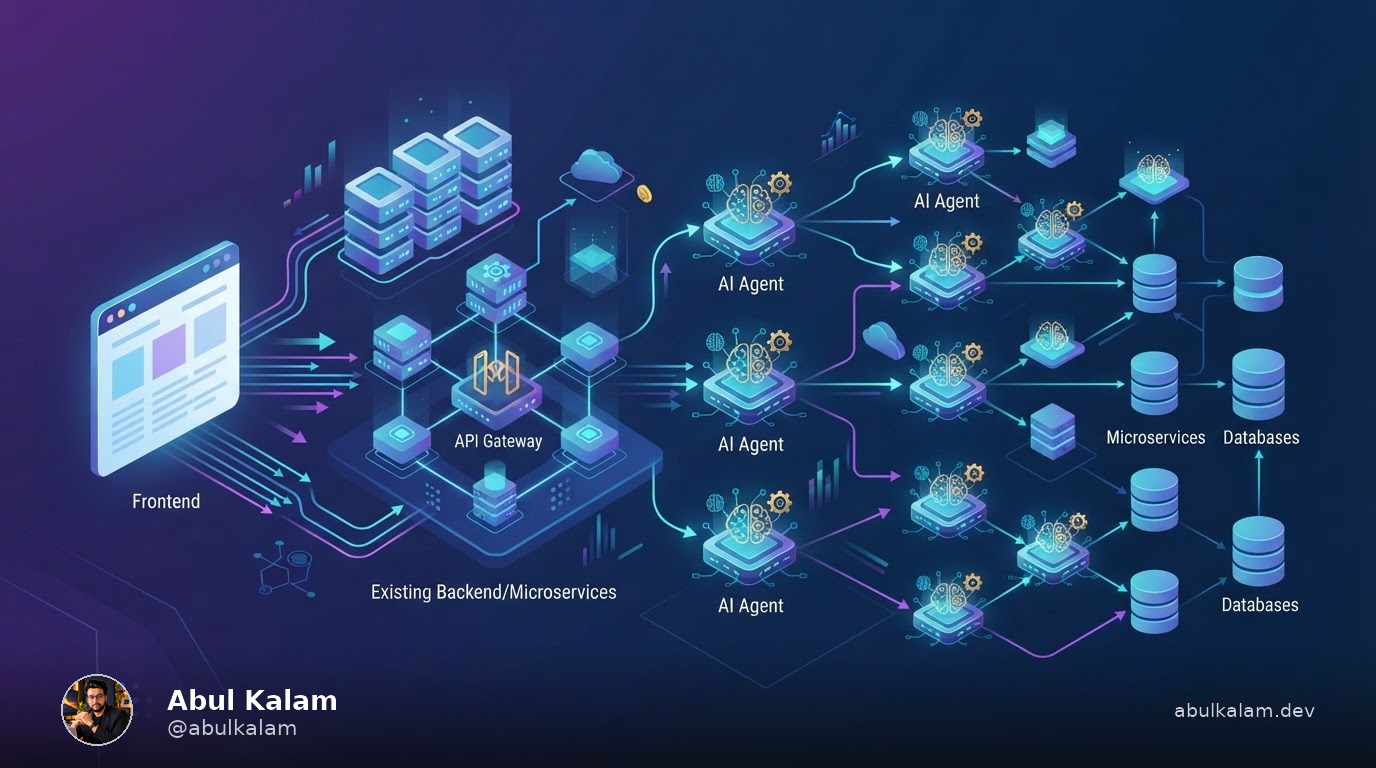
Implementing seamless AI agent integration into existing production web applications is one of the most demanding engineering challenges full-stack teams face today. While spinning up a single prototype with an API key and a prompt wrapper takes minutes, deploying autonomous agents that interact with operational databases, run multi-step tool calls, and preserve low latency demands disciplined systems design. As founder of ITcians and senior software engineer Abul Kalam has observed across diverse enterprise client systems, attempting to force non-deterministic agent workflows into traditional synchronous architectures inevitably introduces severe operational bottlenecks.
The Hidden Bottleneck of Synchronous Agent Invocations
Conventional web backends operate on a predictable request-response contract: an incoming HTTP request hits an endpoint, executes a database query or calls an internal microservice, and responds within 50 to 300 milliseconds. AI agents break this paradigm completely.
A single autonomous agent task can trigger iterative reasoning loops, multiple third-party API calls, retrieval-augmented generation (RAG) lookups, and dynamic tool executions. This execution lifecycle frequently spans anywhere from 5 seconds to over 2 minutes. When backends process these agent runs synchronously, web worker threads block, connection pools quickly exhaust, and upstream reverse proxies trigger 504 gateway timeouts. To scale sustainably, developers must rearchitect how their services communicate with and orchestrate autonomous intelligence.
Core Principles for Reliable AI Agent Integration
Achieving resilience requires decoupling agent execution from user-facing transactions. Before diving into architectural patterns, every scalable implementation must adhere to three underlying system principles:
- Non-blocking Execution: User interactions should immediately return an acknowledgment and task identifier, deferring actual agent execution to background workers.
- Deterministic State Hydration: Even if LLM responses are variable, the state machine orchestrating agent steps must remain strictly reproducible and persisted across restarts.
- Least-Privilege Tool Boundaries: Agents should never possess unfiltered database access or raw execution privileges; all tools must execute through strongly typed, validated boundary layers.
5 Production-Grade Patterns for Scaling Agents
1. Asynchronous Ingestion with Persistent Task Queues
The frontend or client application initiates an agent task by posting a payload to a lightweight gateway. Instead of running the agent inline, the API server enqueues a job in a high-throughput broker such as Redis Streams, Apache Kafka, or AWS SQS, returning an HTTP 202 Accepted status with a correlation ID. The user interface either subscribes to an open Server-Sent Events (SSE) stream or relies on WebSockets to receive intermediate thoughts, tool execution statuses, and the final output.
2. Durable Execution and Orchestration Loops
When an agent executes five sequential tool calls and the fourth fails due to a rate limit, the entire workflow should not collapse. Implementing durable execution frameworks like Temporal, Inngest, or custom event-driven state machines enables automatic step-level retries, heartbeat checks, and workflow rehydration. If an underlying container crashes mid-thought, a separate worker can resume the agent task precisely where it stalled without paying duplicate token costs.
3. Isolated Sandboxes for Dynamic Code and Tool Execution
Modern reasoning agents often write and execute ad-hoc code (such as Python scripts or SQL queries) to answer complex user requests. Running generated code inside your primary container network creates immense security vulnerabilities. Routing tool executions to isolated microVMs (such as Firecracker or lightweight serverless runtimes) guarantees strict compute and network boundaries, insulating core databases from unauthorized access or recursive resource exhaustion.
4. Semantic Caching and Context Budgeting
Uncontrolled token usage is both a financial drain and a primary latency driver. High-performance systems implement vector-based semantic caching layers in front of agent invocation pipelines. If an agent previously synthesized a similar data breakdown or answered an identical query within an active context window, the system returns cached outputs directly, completely bypassing unnecessary model inferences.
5. Human-in-the-Loop State Gates
For critical write operations—such as sending marketing campaigns, modifying financial records, or deploying software—agents must not act entirely autonomously. Implementing explicit pause-and-resume interceptors allows agents to halt execution, push an approval request to an operator dashboard or Slack webhook, and sleep until human authorization unblocks the thread.
Telemetry, Observability, and Community Insights
Standard Application Performance Monitoring (APM) tools are rarely equipped to trace complex agent behavior. Full-stack teams must integrate specialized LLM observability pipelines (such as OpenTelemetry wrappers, Langfuse, or Arize) to capture token consumption, latency breakdowns per tool invocation, and prompt drift over time.
These real-world challenges are reflected throughout ongoing developer discussions on Hacker News, where engineers consistently emphasize that handling non-deterministic agents requires treating them like untrusted background microservices rather than conventional static libraries.
Conclusion: Building Resilient Agent Systems
Successful AI agent integration hinges on acknowledging that autonomous models are fundamentally distributed, long-running processes that require defensive system design. By shifting to asynchronous message passing, durable execution state machines, and sandboxed tool environments, engineering teams can build high-velocity full-stack platforms that scale gracefully under real-world production loads.
If you are looking to integrate autonomous AI workflows, modernize your microservices backend, or scale your production infrastructure, explore how Abul Kalam can help guide your architecture from initial prototype to enterprise resilience.


