

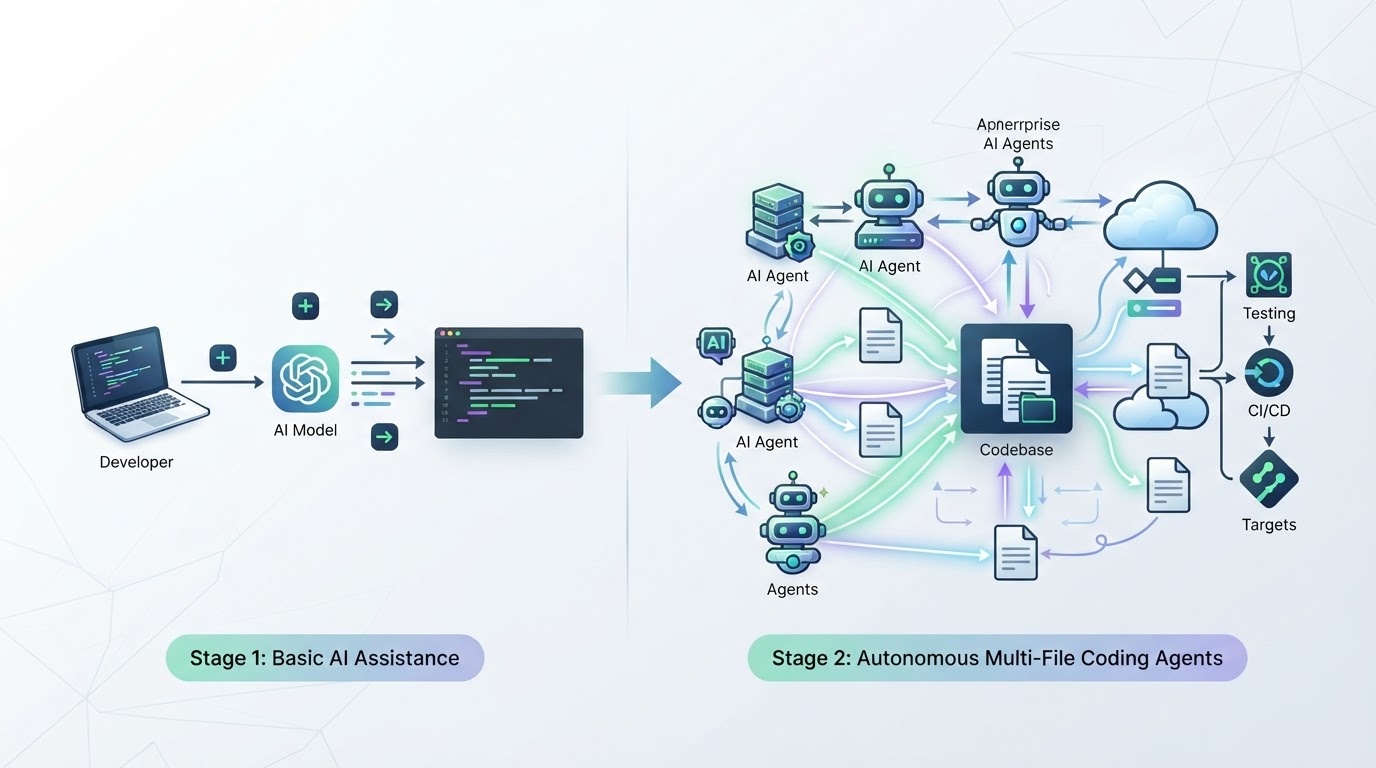
Over the past two years, inline code assistants have become standard developer tooling across modern engineering teams. However, scaling AI agents in production requires a massive paradigm shift away from single-line autocomplete toward autonomous, multi-file software systems that can plan, execute, and verify complex architectural changes.
At Abul Kalam‘s software consultancy and product studio, ITcians LLC, we have observed that treating autonomous agents simply as “larger prompts” is a recipe for broken builds and developer frustration. To deploy agents that reliably generate high-impact pull requests within enterprise lifecycles, teams must solve fundamental system architecture problems spanning repository indexing, tool sandboxing, and deterministic verification.
The Shift from Autocomplete to Autonomous Agent Architectures
Single-turn completions operate within a localized buffer. When a developer types a function header, an LLM predicts the subsequent tokens using the current file and a handful of open tabs as context. While valuable, this paradigm leaves all architectural synthesis, dependency resolution, and runtime debugging entirely to the human engineer.
In contrast, autonomous multi-file coding agents operate in continuous agentic loops. An agent receives a high-level task—such as migrating an API endpoint or adding tenant isolation—and must execute a series of discrete phases: understanding existing codebase patterns, formulating a dependency plan, modifying several interdependent files, and validating the result against a test suite.
As highlighted in recurring developer discussions across Hacker News, the friction point in enterprise environments is rarely model intelligence alone; it is the absence of an execution runtime that allows models to ground their actions in reality.
5 Essential Patterns for Scaling AI Agents in Production
To transition from experimental prototypes to mission-critical engineering workflows, development organizations should implement five core architectural patterns:
1. Abstract Syntax Tree (AST) & Code Graph Indexing
Raw vector embeddings and naive retrieval-augmented generation (RAG) often fail on complex codebases. Semantic similarity does not capture whether Class A inherits from Class B, or how a database migration impacts ORM definitions across multiple microservices. High-performing agent architectures leverage language server protocol (LSP) data and AST graphs to feed structural dependency trees directly into the agent’s context window.
2. Deterministic Verification Loops
An agent should never submit a patch without self-evaluating against automated verification gates. Before presenting changes to human engineers, production systems execute a closed feedback loop:
- Syntax & Type Checking: Fast feedback via TypeScript compiler, mypy, or native compilers.
- Linting & Style Enforcement: Eliminating trivial syntax regressions automatically.
- Unit & Integration Test Execution: Running targeted test suites in an isolated container and piping stderr logs back to the agent for automated remediation.
3. Isolated Sandboxing and Ephemeral Environments
Granting agents shell access on developer machines introduces severe security risks and environment drift. Production-grade agent systems execute file mutations, package installations, and test runners inside ephemeral, lightweight container sandboxes. This prevents arbitrary execution exploits while ensuring repeatable, isolated test runs.
4. Spec-Driven Planning Before Code Generation
When autonomous agents attempt multi-file refactoring in a single pass, context drift frequently leads to orphaned functions and breaking interface changes. Enforcing a strict two-phase protocol—where the agent must first draft and validate a structured implementation plan before generating any code—dramatically reduces hallucination rates across complex repositories.
5. Cost, Latency, and Token Budgeting
Multi-step agent loops can consume millions of tokens per task if left unconstrained. Scaling these systems sustainably requires dynamic model routing: using fast, cost-effective models for dependency exploration and lint parsing, while reserving frontier reasoning models for architectural planning and bug diagnosis.
Common Pitfalls to Avoid
When deploying autonomous coding agents within engineering teams, watch out for the following traps:
- Context Window Bloat: Dumping entire source files into the prompt instead of targeted diffs degrades reasoning capability and spikes inference latency.
- Reviewer Fatigue: If an agent produces 500-line diffs with subtle regressions, senior engineers spend more time reviewing generated code than they would have spent writing it manually.
- Lack of Versioned Rollbacks: Every agent iteration must map cleanly to git commits so that failed explorations can be unwound without human intervention.
Conclusion: Building Resilient Agentic Systems
Successfully scaling AI agents in production requires shifting your mindset from prompt engineering to rigorous systems architecture. By combining graph-aware code indexing, sandboxed tool execution, and deterministic test loops, software organizations can empower engineering teams with autonomous assistants that safely accelerate delivery without compromising code quality.
Ready to build robust AI integrations and custom agent workflows tailored to your enterprise stack? Explore architectural consulting and full-stack engineering solutions at Abul Kalam to take your product development to the next level.
Hunted & Written by Qalum AI