

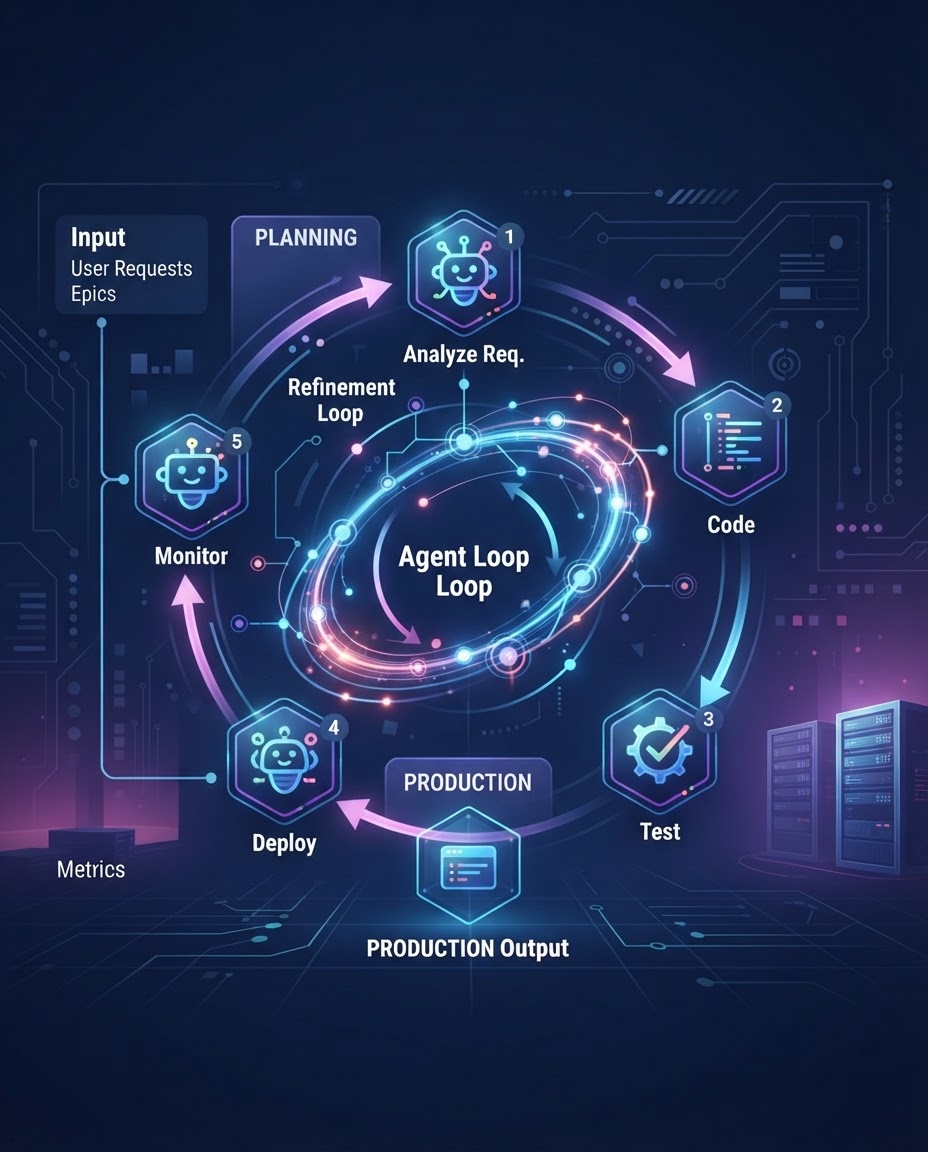
Deploying autonomous AI agents into production workflows represents one of the most consequential architectural shifts in modern software engineering. While building a single-turn prompt wrapper takes minutes, engineering reliable multi-step agent loops capable of managing distributed state, executing external tools, and handling transient failures requires rigorous systems design. At ITcians LLC, led by senior software engineer and product builder Abul Kalam, we have seen engineering teams encounter major friction when transitioning experimental agents into customer-facing environments.
The Limits of Naive LLM Wrappers
During the early days of generative AI adoption, the dominant pattern was straightforward: take an end-user query, construct a system prompt, invoke a language model endpoint, and return the response. This pattern excels for summarization, drafting, and simple question-answering. However, production software demands goal-oriented autonomy—the ability to decompose a high-level objective, choose appropriate tools, verify intermediate outputs, and self-correct when an API call fails.
Recent technical analyses and real-world implementation stories highlighted in discussions across the Hacker News community underscore why naive ReAct loops collapse in enterprise settings. Unbounded loops regularly get trapped in cyclic hallucination states, consume runaway token budgets, and lack deterministic rollback mechanisms when external side effects occur.
Architecting Autonomous AI Agents for Enterprise Reliability
To operate autonomous agents safely in mission-critical environments, software engineers must replace unconstrained autonomy with structured, stateful orchestration. Production-ready architectures typically rely on three fundamental building blocks:
1. Deterministic State Graphs
Rather than letting an LLM freely determine every subsequent execution step indefinitely, mature systems implement directed acyclic graphs (DAGs) or finite state machines (FSMs). In this setup, the language model acts as an intelligent router or transformation engine within strictly defined state transitions. If an agent fails to extract required parameters after two iterations, the state machine forcibly routes execution to a designated fallback handler.
2. Idempotent Tool Execution and Secure Sandboxing
When autonomous agents interface with databases, third-party APIs, or terminal environments, side effects become permanent. Engineering teams must treat model-invoked tools as potentially untrusted inputs:
- Strict Schema Validation: Enforce strict JSON Schema or Pydantic validation before any function executes.
- Idempotency Keys: Prevent duplicate billing charges or redundant database mutations when agents retry failed reasoning steps.
- Sandboxed Environments: Execute dynamic code generation inside ephemeral microVMs or isolated containers with zero access to production secrets.
3. Comprehensive Observability and Evaluation
Traditional application performance monitoring (APM) tracks latency, memory, and CPU usage. For autonomous agents, observability must also capture the complete decision trace: system prompts, intermediate model outputs, tool payloads, token consumption, and confidence evaluations. Instrumenting OpenTelemetry spans across every node of your agentic graph is essential for pinpointing exactly where reasoning drifted off track.
Human-in-the-Loop Governance
True operational maturity rarely means 100% unsupervised autonomy. The most effective enterprise systems define explicit risk tiers for agent actions. Non-destructive operations (such as searching logs or generating reports) run fully autonomously, whereas high-consequence operations (such as deploying code, deleting records, or updating financial ledgers) require a human approval checkpoint before the state machine proceeds.
Mastering Autonomous AI Agents in Your Engineering Stack
The transition from experimental LLM wrappers to resilient, scalable autonomous AI agents marks the foundation of modern intelligent software delivery. As teams navigate these architectural shifts, prioritizing deterministic guardrails, rigorous telemetry, and structured state machines will separate robust software from fragile prototypes. To explore practical AI integration strategies, full-stack architectural leadership, and production-tested software consulting, visit abulkalam.dev to start building reliable solutions for your business today.
Hunted & Written by Qalum AI