

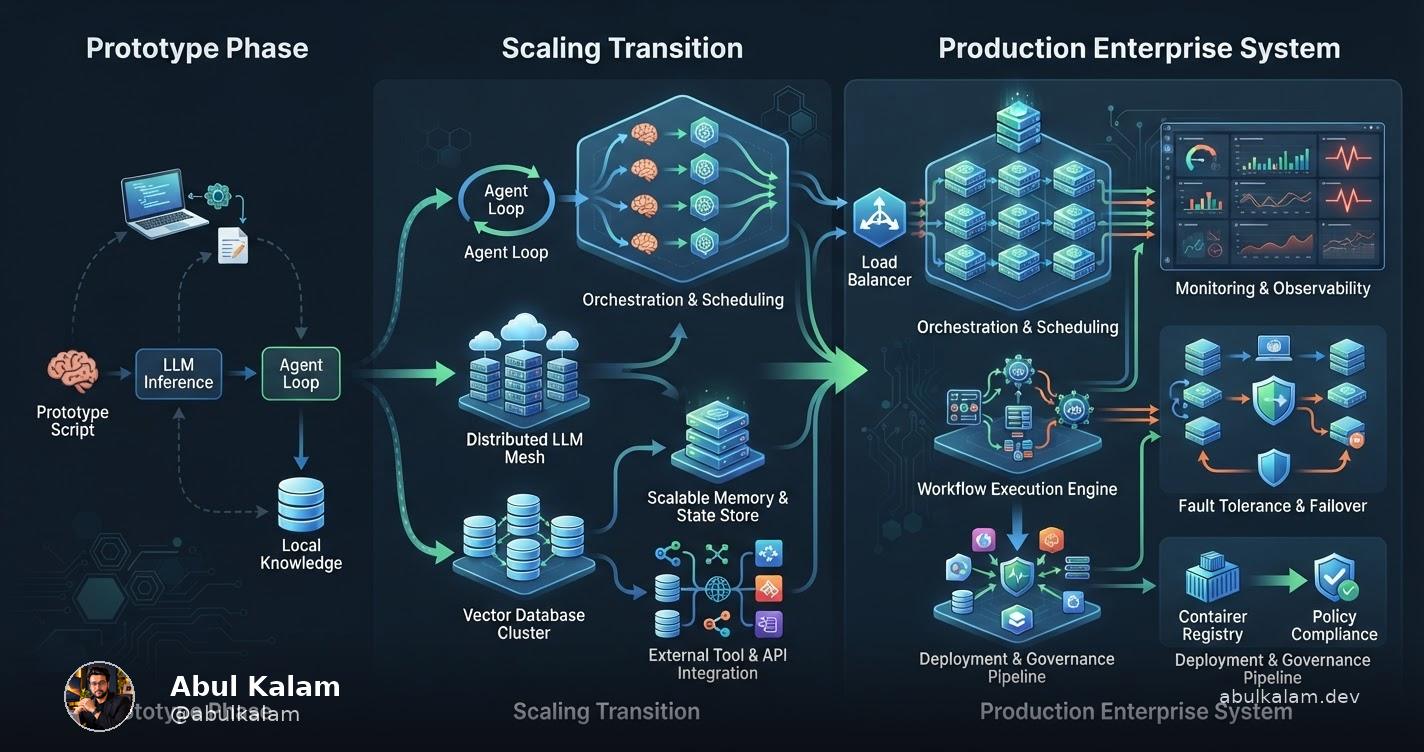
Moving from a proof-of-concept Python script to an enterprise-grade software system requires a fundamental architectural rethink. Scaling autonomous AI agents in mission-critical environments is no longer about clever prompt engineering; it demands the same rigorous distributed systems principles that underpin high-throughput cloud infrastructure. At Abul Kalam, where we build and scale modern AI integrations and web platforms, we have seen engineering teams repeatedly hit roadblocks when treating probabilistic language models like deterministic microservices.
The Reality Gap Between Agent Prototypes and Production
Most autonomous agent demonstrations follow an optimistic path: an LLM receives an objective, generates sub-tasks, calls a mock API, and outputs a clean result. In production, however, network partitions occur, third-party APIs return rate limits, and context windows fill up with redundant reasoning loops. As frequently highlighted across engineering discussions on Hacker News, the primary friction point in enterprise agent adoption is rarely model capability—it is systemic reliability, operational observability, and unbounded token consumption.
When an autonomous agent operates without hard execution boundaries, single-turn failures compound exponentially. An unhandled response from an external database or payment gateway can cause the agent to misunderstand its current state, triggering repetitive, hallucinated tool calls that spike cloud bills and degrade customer experience.
Core Architectural Pillars for Scaling Autonomous AI Agents
To transition autonomous agents from unpredictable scripts into stable enterprise components, developers must enforce strict boundaries around model behavior. Below are the foundational architectural patterns required for scalable agent deployments.
1. Deterministic State Machines Over Freeform Loops
Autonomous agents should never run in unconstrained while-loops. Instead, structure your agentic architecture around finite state machines (FSMs) or directed acyclic graphs (DAGs). Each node in the graph represents a distinct phase of execution—such as intent extraction, context retrieval, planning, tool execution, and synthesis.
By enforcing deterministic transitions between these states, your software retains full control over the workflow. If an agent fails to extract parameters for a tool, the state machine routes the context to a dedicated error-recovery node or alerts a human operator rather than allowing the model to wander off course.
2. Transactional Tool Sandboxing and Idempotency
When an autonomous agent interacts with databases, CRM platforms, or internal APIs, every tool execution must be treated as a potentially destructive operation. Implement strict idempotency keys for all mutating API requests to ensure that retry loops do not trigger duplicate database writes or repeated external webhooks.
Furthermore, execute tools inside isolated runtime sandboxes with principle-of-least-privilege permissions. Agents should receive ephemeral credentials with scope limited strictly to the immediate task, preventing unintended privilege escalation during runtime.
3. Hierarchical Context Windows and Memory Caching
Feeding an entire execution history back into an LLM context window quickly degrades reasoning accuracy and inflates latency. Scalable architectures use hierarchical memory tiers:
- Working Context: A minimal, structured scratchpad containing only the current sub-task objective and the immediate input schema.
- Episodic Memory: A vector or relational store containing summarized checkpoints of past agent steps, retrieved selectively via semantic search.
- Long-Term Knowledge: Pre-indexed organizational databases and document repositories queried on demand through isolated retrieval pipelines.
4. Automated Evals as Continuous Deployment Gates
You cannot scale what you cannot benchmark. Every modification to an agent’s system prompt, orchestration code, or underlying foundation model requires automated trajectory evaluation. Create a regression test suite composed of historical production edge cases to score agent accuracy, tool call correctness, and latency before deploying updates to production.
Managing Failure Modes: Observability and Guardrails
Comprehensive observability is essential when running autonomous workflows in enterprise production environments. Standard server logs are insufficient; you need end-to-end distributed tracing that captures every intermediate prompt, token count, tool payload, and decision boundary across the execution chain.
A resilient agent infrastructure incorporates explicit operational safeguards:
- Circuit Breakers: Automatically halt agent execution loops when API error thresholds, recursion depths, or token expenditure budgets are reached.
- Strict Schema Validation: Enforce rigorous schema validation (such as Pydantic or Zod) on all tool arguments generated by the model before invocation.
- Human-in-the-Loop Interceptors: Route high-risk transactions—such as bulk deletions or financial mutations—to human verification dashboards before execution.
- Deterministic Fallback Strategies: Default to static rule-based handlers or specialized heuristic algorithms whenever the LLM output violates structural constraints.
Conclusion: Building Resilient Autonomous Systems
Successfully scaling autonomous AI agents demands shifting our engineering mindset from open-ended experimentation to disciplined systems engineering. By enclosing probabilistic model outputs within deterministic state machines, securing tool sandboxes, and establishing automated evaluation pipelines, engineering teams can build AI-powered systems that operate reliably at scale.
If you are planning to build or modernize your enterprise software with dependable AI workflows, explore how Abul Kalam can help you design, engineer, and deploy production-ready AI architectures that scale seamlessly with your business.