

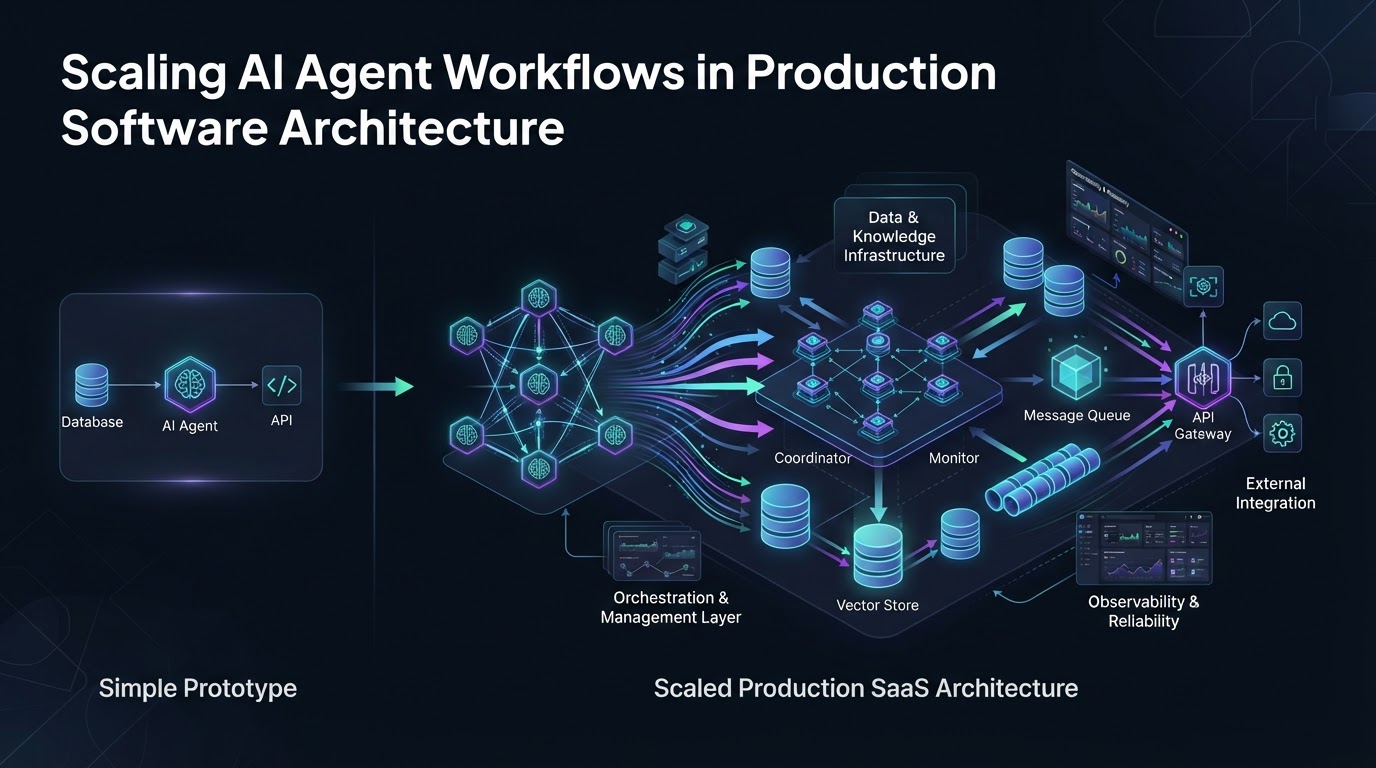
Scaling AI agent workflows into mission-critical production environments requires shifting our perspective from prompt engineering to robust distributed systems design. While proof-of-concept autonomous agents excel in controlled sandboxes, enterprise software demands strict determinism, fault tolerance, and predictable latency. As a Senior Software Engineer and founder, I, Abul Kalam, have spent years engineering scalable cloud systems and integrating AI features that deliver real business impact.
Recent technical debates across tech communities and developer discussions on Hacker News highlight a universal pain point: agent loops break easily when scaled across concurrent users. When an LLM hallucinations cascade into external API calls, unhandled exceptions quickly corrupt user state. Bridging the gap between an experimental agent script and enterprise-grade software architecture requires proven architectural patterns.
The Fundamental Challenge with Autonomous Agent Loops
Most basic AI agent tutorials rely on unbounded ReAct (Reasoning and Acting) loops. The agent receives a prompt, calls a tool, inspects the result, and iterates until it decides the task is finished. In production SaaS, this naive loop introduces critical vulnerabilities:
- Non-deterministic termination: The agent may enter circular reasoning, exhausting token limits and running up massive API bills.
- Lack of transactional integrity: If an agent modifies external database records during step three and fails during step four, the application is left in an inconsistent state.
- Unbounded latency: Multi-step reasoning chains can take 30 to 90 seconds, causing HTTP timeouts and poor user experience.
Architectural Patterns for Scaling AI Agent Workflows
To run autonomous agents reliably at scale, software architects must wrap probabilistic language models within deterministic distributed harnesses. Here are the core patterns we use when designing production systems at ITcians LLC.
1. Enforce Finite State Machine Orchestration
Never allow an LLM full autonomy over the macro-level routing of your application. Instead, model the workflow as an explicit Finite State Machine (FSM) or Directed Acyclic Graph (DAG). The LLM should evaluate inputs and suggest transitions, but the orchestrator strictly enforces valid paths, preconditions, and transition rules. This prevents catastrophic loop drifts and guarantees business constraints.
2. Queue-Backed Asynchronous Execution
Production agent workflows should never execute synchronously on request threads. Instead, decouple the trigger from execution using reliable message queues such as Apache Kafka, RabbitMQ, or AWS SQS. Wrap agent tasks inside durable execution engines like Temporal or custom Celery/BullMQ pipelines. This guarantees that if a worker crashes or an upstream LLM provider rate-limits your API keys, the agent workflow resumes from the exact checkpoint without data loss.
3. Idempotent Tool Interfaces
Because network retries and LLM hallucinations are inevitable, every external tool an agent can invoke must be strictly idempotent. Whether updating a billing record, sending an email, or mutating a cloud resource, tools must require a unique idempotency key derived from the workflow step ID. If an agent repeats an action, your backend must safely return the cached result rather than duplicating the side effect.
4. Sandboxed Tool Execution and RBAC
Agents should never operate with elevated system privileges. Implement strict Role-Based Access Control (RBAC) at the tool interface level. If an agent executes code, evaluate it inside ephemeral micro-VMs or secure containers with constrained network access and CPU limits. Limit database access to scoped service tokens rather than granting broad read-write credentials.
5. Granular Telemetry and Guardrails
Standard application performance monitoring (APM) tools are insufficient for probabilistic workflows. You need continuous distributed tracing across every step: recording token consumption, prompt versions, schema validations, and downstream latency. Integrate runtime guardrails that validate structured JSON outputs against strict Pydantic or Zod schemas before allowing any tool execution.
Transitioning from Prototype to Production SaaS
Building scalable AI systems is not about chasing the newest foundational model release every week. It is about applying proven software engineering discipline to emerging AI capabilities. When you isolate probabilistic intelligence inside deterministic, observable, and resilient software boundaries, AI agents stop being risky experiments and become formidable competitive advantages.
Whether you are modernizing existing enterprise platforms or embedding autonomous capabilities into a new product, getting the foundational architecture right from day one will save months of technical debt. If you are ready to evaluate, build, or deploy resilient AI integrations and scalable software for your team, explore our engineering services and connect directly at abulkalam.dev.
Hunted & Written by Qalum AI