

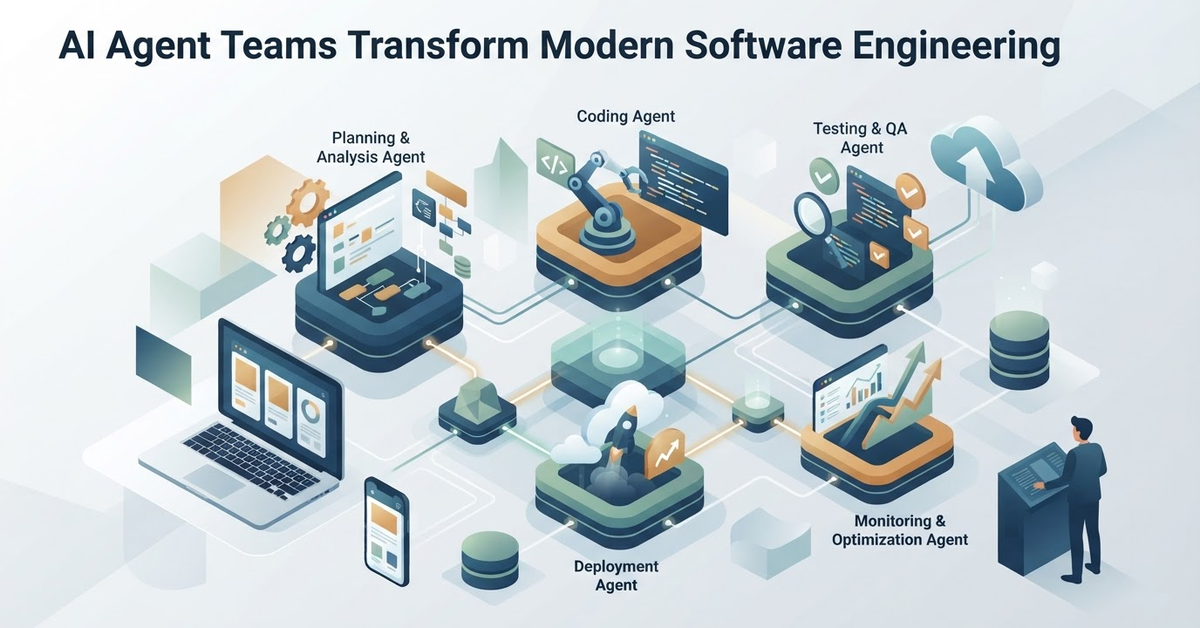
Autonomous AI agent teams are rapidly redefining how modern engineering organizations conceptualize, write, and maintain production codebases. While developer attention initially centered on basic line-level autocompletion, real-world engineering demands cross-module coherence, continuous test execution, and end-to-end task decomposition. Today, progressive development teams are replacing single-line completions with coordinated agentic workflows capable of driving complex feature implementation autonomously.
The Limitations of Single-Line Autocomplete
Inline code completion revolutionized developer velocity by anticipating repetitive syntax and function calls. However, production software engineering rarely fails at the syntax layer; it fails at the architectural and dependency layers. Autocomplete assistants operate on localized context windows, often blind to how a schema modification in your database tier impacts your API serialization logic or frontend state management.
Recent developer discussions across Hacker News highlight an industry-wide fatigue with shallow AI suggestions that introduce hidden regressions. When developers spend more time debugging hallucinated method signatures than writing code, developer velocity suffers. The modern stack requires systems that reason about entire systems, not just isolated cursors.
How AI Agent Teams Coordinate Across the Stack
Unlike standalone code generators, an agentic engineering setup delegates tasks to specialized sub-agents working in a closed execution loop. Each agent is responsible for an isolated domain of the software lifecycle, communicating via structured outputs and shared context.
- The Planner Agent: Deconstructs product requirements, maps architectural dependencies, and outlines the precise sequence of file updates required.
- The Implementation Agent: Writes context-aware code across backend routes, database migrations, and client components using strict workspace context.
- The Test & Verifier Agent: Executes local test suites, analyzes stack traces, and loops back to patch implementation defects until all test cases pass.
- The Reviewer Agent: Audits the diff against performance, security, and repository conventions before packaging a clean pull request.
From Human Typist to Engineering Conductor
This paradigm shift redefines seniority in software development. Rather than measuring output by lines of committed code, engineers increasingly evaluate performance through system orchestration, interface design, and prompt architecture. The developer becomes a conductor who specifies system contracts, configures guardrails, and validates edge cases while AI agents handle mechanical implementation.
Overcoming Context Windows and State Management
The true technological enabler for agentic development is advanced context retrieval. By indexing codebases into localized vector spaces and AST-based graph databases, AI agents can retrieve exact call hierarchies and type definitions on demand. This structured context eliminates common hallucination patterns and enables multi-file refactoring without degrading memory or reasoning limits.
Building Future-Ready Engineering Workflows
Embracing agentic workflows requires teams to invest in strong automated testing, robust linting, and clear architectural boundaries. Without continuous automated validation, autonomous agents can compound technical debt. With strong guardrails, however, they multiply developer output by an order of magnitude.
As founded by Abul Kalam, our focus is on building resilient digital products and integrating pragmatic AI workflows that deliver measurable business impact. If you are exploring how to modernize your engineering stack or integrate custom AI agents into your development pipeline, get in touch through our portfolio and consultation page to discuss building your next-generation software architecture.
Hunted & Written by Qalum AI


